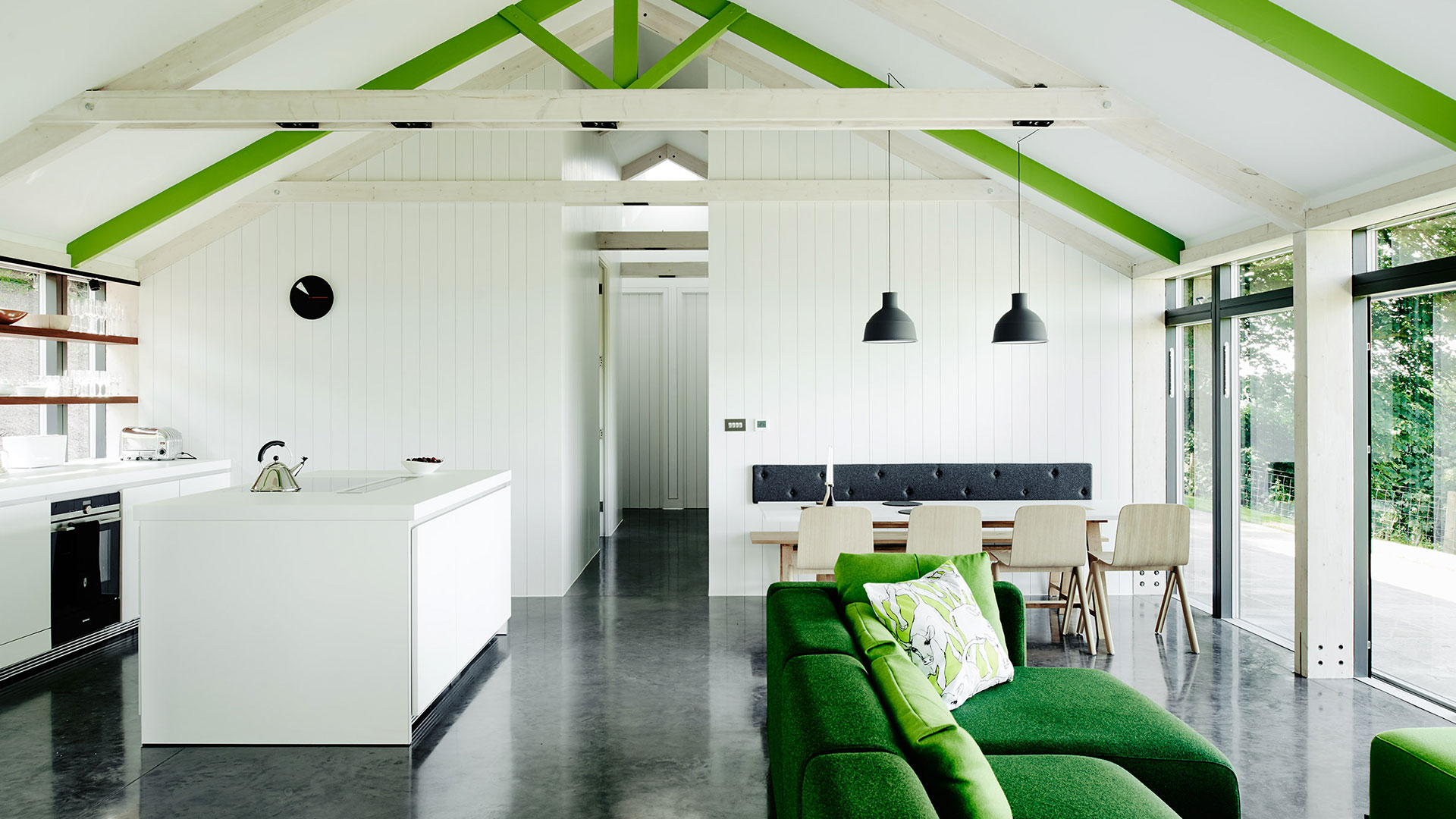
This remodelling of a large semi-detached house in Abergavenny replaces a cramped kitchen extension with a lofty glazed space, and creates a dramatic new relationship with the property’s generous garden. Inserting a stepped light-well into the space between the original house and the new orangery transforms the main property’s lower ground floor into a light, flexible space used to accomodate a generous new kitchen. Floor-to ceiling concertina doors connect the kitchen to the new outdoor space and enhance natural light levels. The new orangery has direct links to the main house on two levels, and opens straight out onto the garden.
Being a semi-detached property, the roofline of the orangery matches that of the neighbouring building and respects their shared composition. The original slate roof is supported on a slender steel and glass frame, which acts as a modern reading of the form it replaces. The orangery’s extensive glazing is subdivided in rhythms derived from the varied window openings of the original victorian house.
» Return to top
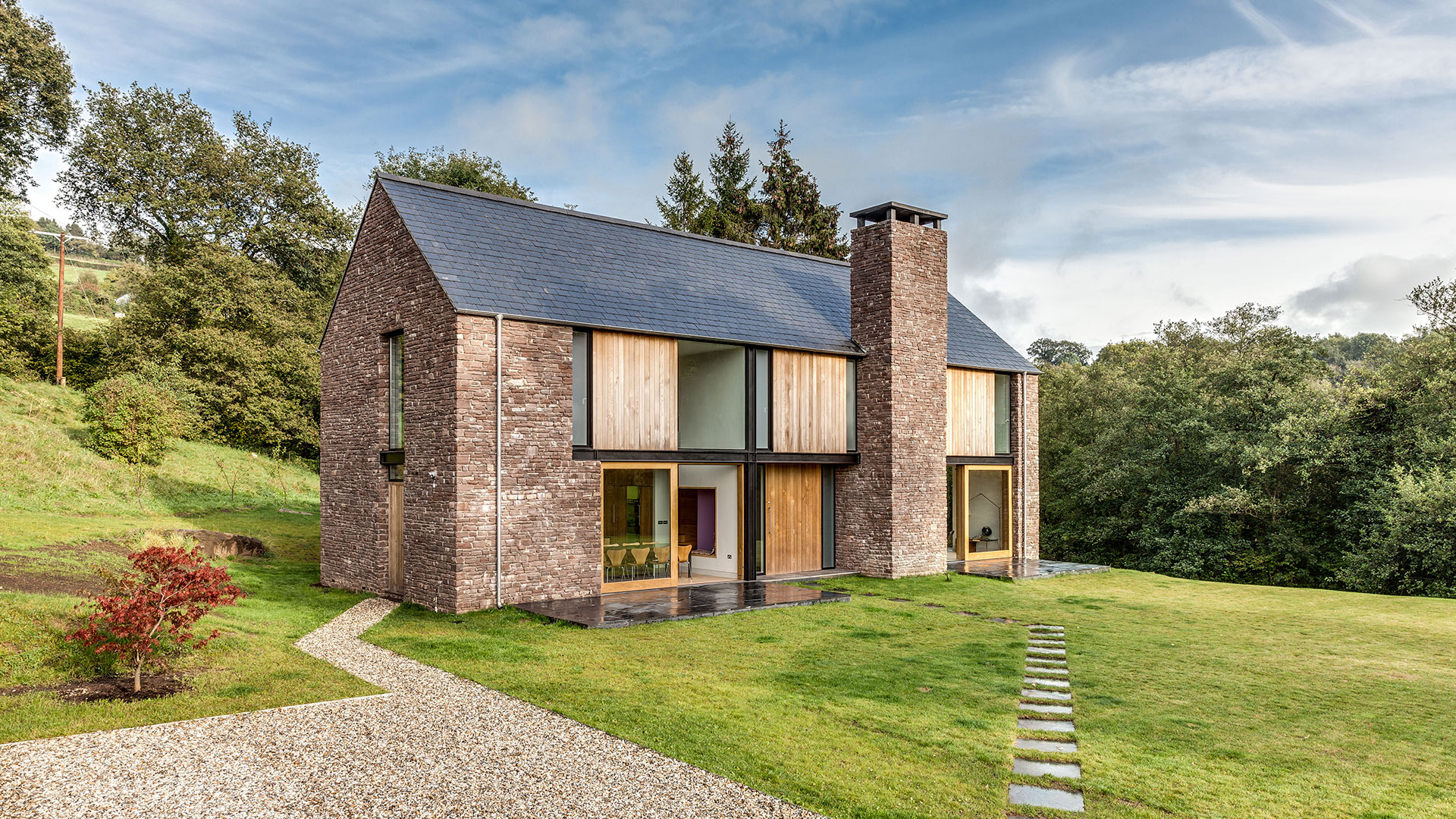
Planning permission was granted in summer 2005 for the construction of this new 100m² home in the Wye Valley, an Area of Outstanding Natural Beauty. The house construction uses reclaimed stone from the site and is very highly insulated. The flowing, open-plan design enables this relatively small home to enjoy an expansive feel, with a double height volume in the main living room. High performance glazing in strategic locations is used to celebrate the views over the surrounding countryside.
Photovoltaic cells on the south facing roof supplement mains electricity, grey water is recycled and the building is orientated to benefit from passive solar heat gain without risk of overheating. The building is carved into the northern bank of the site which provides a protected position and enables the two storey building to have reduced visual impact on its surroundings. A sedum planted deck creates a constant garden for the balcony which is accessed from the master bedroom and commands outstanding views over the Wye Valley.
This private residence overlooking the River Usk and the Ryder Cup golf course of Celtic Manor was granted full planning permission in July 2007, and is scheduled for completion in 2009. With a floor plan exceeding 500m², this luxurious modern home seeks to derive maximum benefit from outstanding panoramic views along the Vale of Usk.
The building, which replaces a small and neglected farmhouse, seeks to respond to its location in a number of ways. The semi-elliptical plan, inspired by the curving forms of the river it overlooks, enables 180° panoramic views, while wrapping around a south-facing courtyard creates shelter from prevailing winds and road noise that pass along the valley. The sloping hillside close to the rear of the house is scooped out into a re-graded ellipse, giving a breathing space to the elevations, and allowing low-angled winter light to penetrate the living accommodation The curving form and use of contextual materials help to place the building gently within thin landscape, while newly planted trees form a halo of vegetation that soften the building’s silhouette.
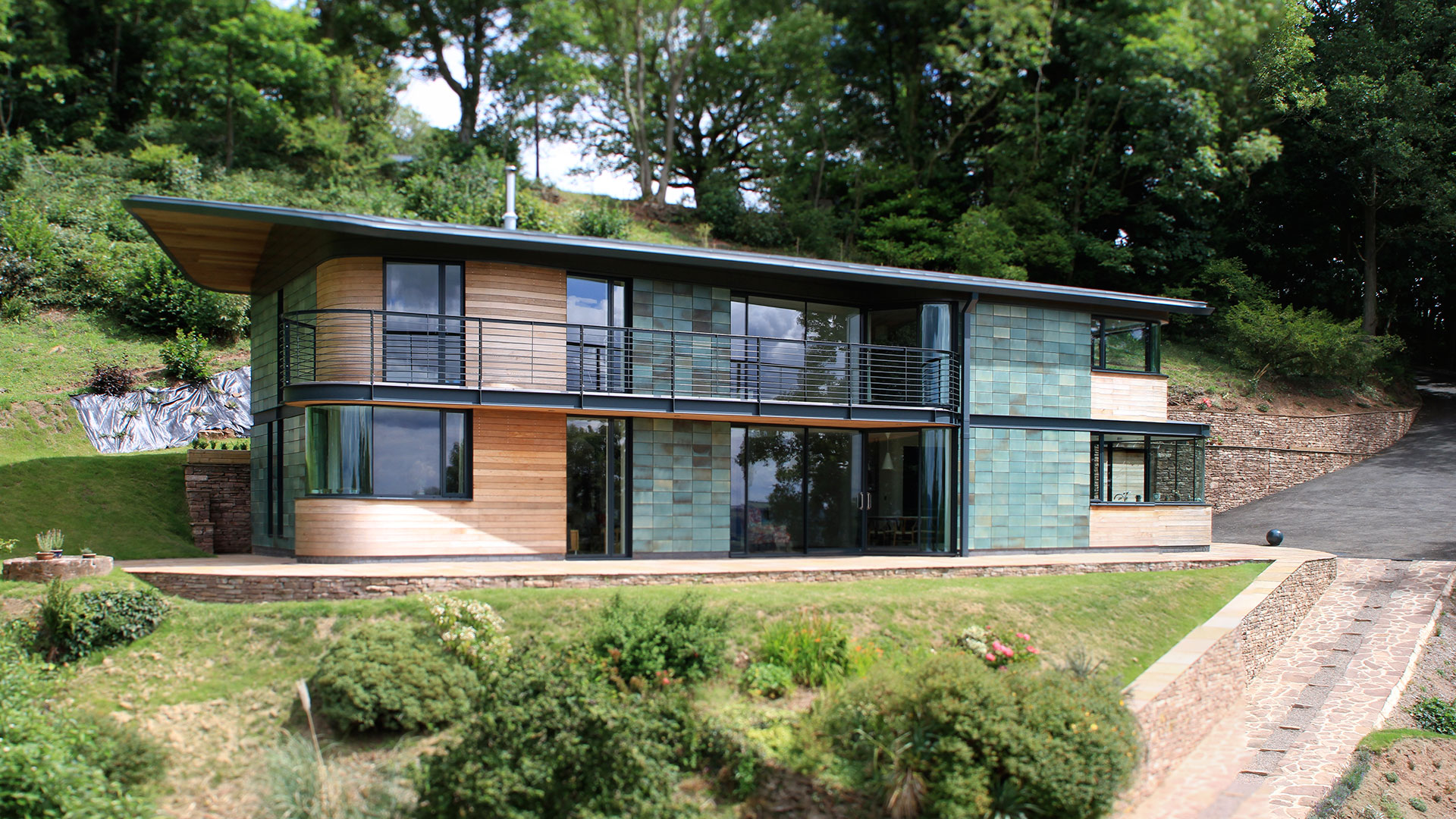
This four bedroom home replaces a sprawling linear house located on a terraced hillside site of 4.5 acres (2.5 hectare) with commanding views over the vale of Usk. Its flowing organic form was inspired by the rippling topographic contours of the site, and have the effect of creating a series of sinuous spaces that address particular vantage points.
The building’s ground floor ‘hunkers’ down into the steeply sloping hillside and projects out over a man-made terrace which faces South West and gains considerable afternoon sun. The flowing floorplans overlap to create balconies and external bay projections. The intention is to emphasize distinct spatial sensations, including a central double height space which capture particular views within the different parts of the building. The over-sailing roof and generous balconies protect the glazed elevations from over-exposure to solar heat gain during Summer months. Oxidized copper rainscreen tiles are incorporated into the elevations, creating a subtle camouflaging effect due to their patinated green surface texture and reflecting the client’s passion for ceramics.
Environmental strategies such as the incorporation of a ground-source heat pump, passive ventilation, and careful solar design aim to ensure the property has an extremely low carbon footprint.
Cwm-y-Cwcu – ‘cuckoo valley’ is a secluded cottage set within open countryside near the River Usk. Typical of many houses in the region, the existing building occupies a generous garden, but has little interaction with it, and has suffered from an awkward and slightly cramped layout.
By adding a carefully-scaled new extension, resolving previous enlargement works, and re-orientating the internal circulation, the building is transformed into a spacious and light-filled country residence. Generous glazing on the approach elevation gives the building a much more welcoming aspect. A large family kitchen flows into a generous living room, with both spaces linking directly to the garden. The character of the original cottage is carefully retained, while the new elements of the building adopt a contextual modern design. A vertical band of glass clearly expresses the junction between the original and new construction, and the incorporation of a stainless steel chimney flue gives additional emphasis to this element of the building.
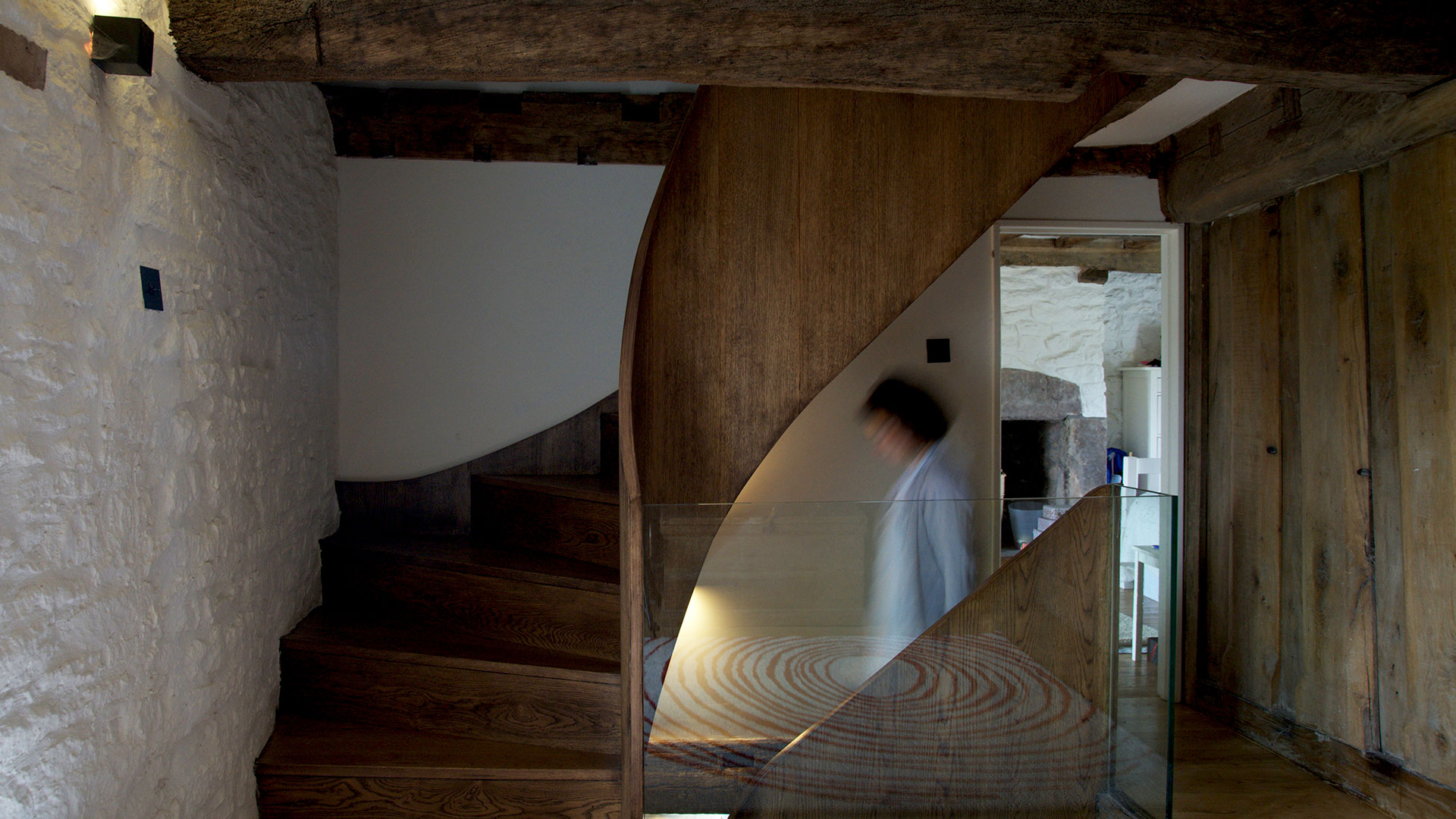
Completed in 2006, this project comprised the gutting and remodeling of a dilapidated 200 year old warehouse to create a 480m² (5200ft²) mixed-use property combining offices, studios and residential apartments. The Grade II listed building is transformed by a combination of sensitive restoration, carefully considered interventions and modern new-build construction.
The scheme retains the industrial building’s distinctive open plan spaces, and reveals its original materials and construction techniques. The modern extension, which addresses a rear courtyard, adopts a taut modern design with pronounced asymmetrical massing, cantilevering balconies and a sinuous central staircase. A slice of horizontal glazing brings light into the centre of the building’s deep plan and serves to define the transition between the old and new parts of the building. Metal framed glazing, with its design adjusted to reflect both the traditional and modern portions of the building, provides a unifying visual link.
The building was featured in ‘Space’, The Guardian’s weekend design supplement, in November 2006.
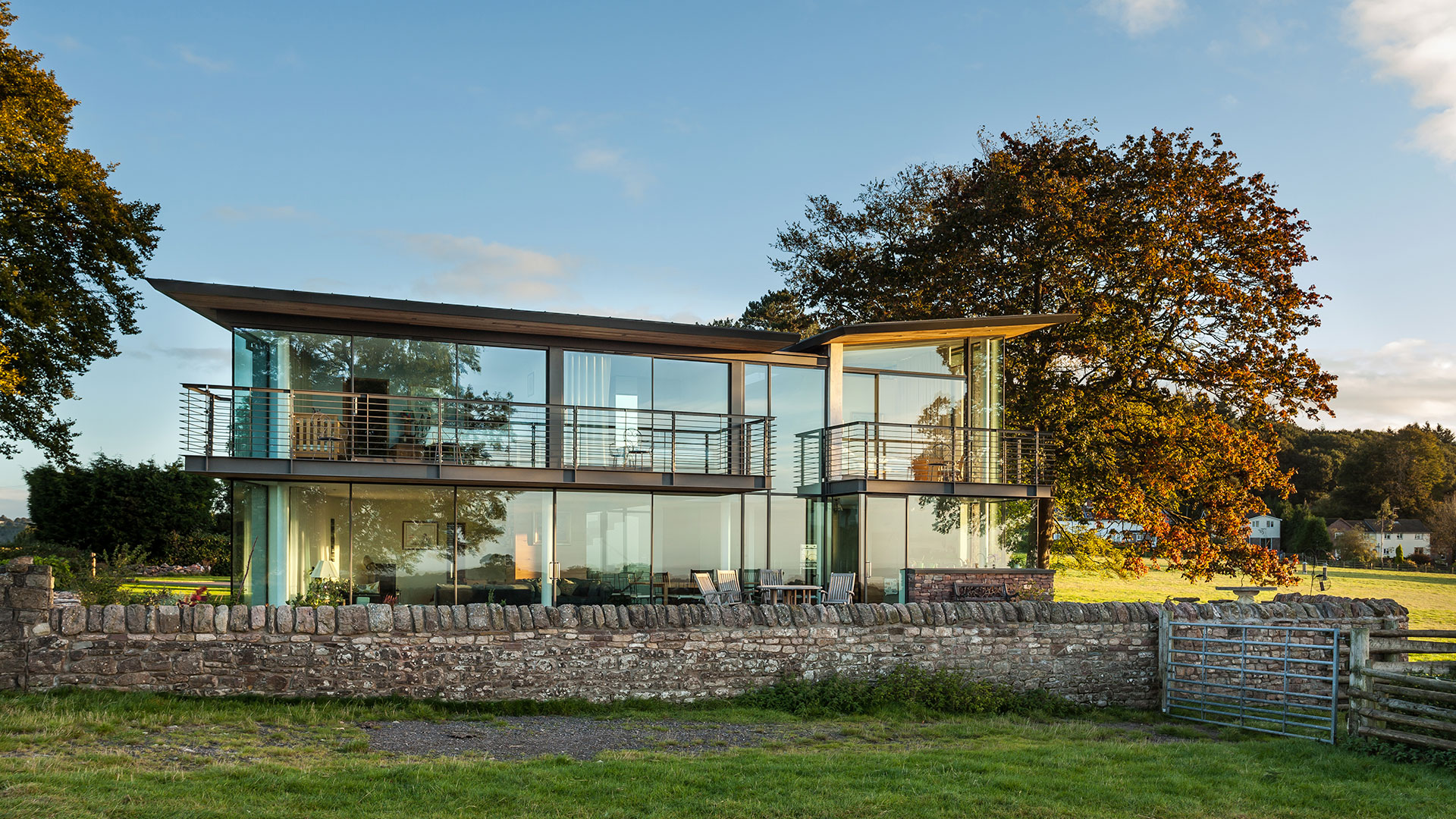
This proposed private residence occupies a secluded location with an exceptional vantage point offering 270º panoramic views over an Area of Outstanding Natural Beauty covering the Wye Valley, Severn Estuary and south Monmouthshire.
The design, which is a replacement for an existing dwelling, aims to achieve a generous sense of space within a limited external volume. A double height glazed space unites two distinct wings within an L shaped plan. The design seeks to contrast solidity with transparency. Gently curved stone walls on the northern elevations wrap around the building and echo the surrounding agricultural landscape. Slim framed floor to ceiling glazing provides unrestricted views over rolling farmland to the south. Overhanging balconies provide solar protection for this transparent south elevation. An open plan ground floor layout incorporates a double height volume overlooked by a mezzanine, and benefits from a dramatic sense of light and space.
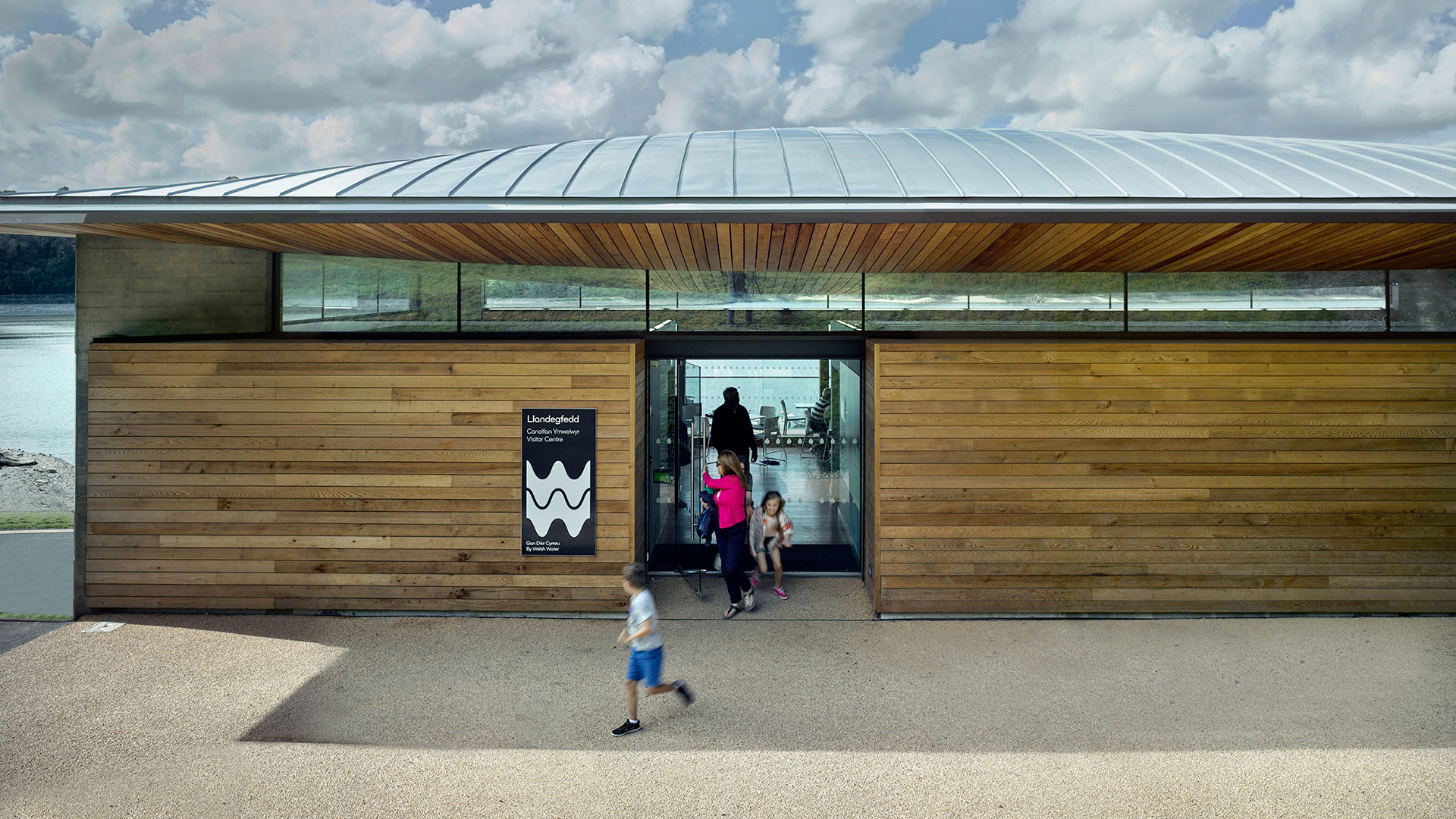
This 120m² pavilion building will provide multi-purpose facilities for a cruise service which navigates the River Wye. It is located on the river bank within the grounds of Chepstow Castle, an 11th Century Scheduled Ancient Monument. Its low-lying form incorporates an inverted roof which helps to minimise the building’s impact on protected views within the Wye Valley Area of Outstanding Beauty.
The single storey structure comprises a café, waiting room, toilets, serving counter and kitchen, administration office and store room. Concertina doors enable the building’s glazed river elevation to open fully onto an expansive cantilevered deck.
An articulated gangway suspended from a gantry provides pedestrian access to the river, which has an exceptionally high tidal range. Full planning permission was granted in June 2007 and construction is scheduled for 2008-9.
This covered outdoor classroom for 30 young school children was created using a tensile fabric structure. The timber arches create a soft embracing form that keeps the eaves line of the roof low, providing maximum protection from rainfall.
The 80m² teaching facility incorporates curved bench seating formed from larch slats. The bench seats cantilever from galvanized steel struts tied in to the underside of the structure’s primary timber arches. Integrating the furniture in this way creates a ready-made teaching environment which is always ready for use.
A leaf-green coloured rubberized tarmac floor completes the child-friendly environment. The use of a translucent fabric canopy provides a glowing, naturally-lit space with the intention of creating an inspiring place of learning.
This project gives the organizers of Chepstow Festival a means of creating a temporary roof covering for summer audiences attending theatre performances at Chepstow Castle. The proposal secured funding from the Welsh Assembly Government following a successful submission for EU support. After considerable design development, planning permission, in the form of Scheduled Ancient Monument Consent was granted by CADW, Wales’s heritage body.
The lightweight membrane roof provides coverage for over 300 spectators, while minimizing the structural interference and physical contact with the walls and ground of the castle. Lightweight masts and high tension cables enable the structure to be rapidly assembled and placed in storage, providing a flexible amenity which transforms the inner courtyard by creating a covered amphitheatre. The design is an economical and demountable solution to the uncertainties of a British summer.
Hall + Bednarczyk were appointed as architects in 2005 for this key outdoor activity centre in Gloucestershire, which provides the UK’s deepest inland scuba-diving facility. The practice’s commission required the masterplanning of a 55 acre site comprising a former quarry and woodland. Acting as architects for all of the site’s proposed buildings including a new Diving Centre, hotel and visitor accommodation, and forty holiday lodges, Hall + Bednarczyk secured planning permission for the National Diving and Activity Centre in November 2006.
Preparatory work, including the construction of a new site entrance, is scheduled for completion by mid 2008. The ambitious plans which have been approved for the site enable the creation of one of South West England’s leading adventure sport locations. The modern buildings proposed throughout the site aim to achieve outstanding environmental performance, in keeping with the centre’s passion for the preserving the great outdoors.
Competition Winning Design 2006 Hall + Bednarczyk’s proposal for a temporary demountable opera house was chosen as the winning design for the Royal Borough of Kensington & Chelsea’s annual outdoor opera season staged in Holland Park. The scheme, designed with tensile structure specialists Architen Landrell, was selected from an invited shortlist which included proposals by world-renowned architects.
The facility is required to be temporary due to its parkland location adjacent to Grade 1 listed Holland House. The design seeks to resolve the practical needs of a rapidly demountable audience facility with the desire for a luxurious opera house. An over-sailing tensile fabric roof provides a free-spanning cover for the entire facility, suspended from two 18m high V masts.
A stacking system of pre-fabricated units, derived from temporary modular buildings, provides a habitable structure forming large hospitality spaces, while supporting grandstand seating for 1,000 audience members. A pre-fabricated set of timber clad steel balconies bolt to the stacked modular frame, creating a dramatic full width cantilevered frontage. The system can be craned into position in a 3 day period, followed by a 2 week fit out period.
Following a competition held by Public Art Wales, Hall + Bednarcyk were appointed with artist Howard Bowcott from a field of 34 entries to undertake the design of a new perfomance venue at Eirias Park.
The design comprises a flexible performance space, part of which can be rotated into different positions, enabling it to operate as an intimate venue for 100+ spectators, or alternatively to address a large landscaped amphitheatre for audiences in excess of 1000 people.
The structure is located on a peninsula which projects into Eirias Park lake, forming a scupltural presence which takes advantage of the water’s reflective surface. The structure, clad in green oxidised copper, is designed to provide a durable and low maintentance public amenity.
Hall + Bednarczyk Architects is a young practice established in 2005 which focuses on progressive modern design for residential, commercial and public architecture. Since its formation, the practice has won several competitions for public projects, and has been featured in architectural magazines and The Guardian’s design supplement, ‘Space’. The practice has secured a number of prestigious commissions from private clients, public bodies and private companies. A significant proportion of projects are set within sensitive contexts, including historic buildings, protected landscapes and conservation areas.
The practice aims to create elegant buildings that make appropriate use of advanced materials and construction, while remaining sympathetic to their surroundings. Designs incorporate a thorough examination of environmental issues to reduce energy consumption and derive maximum benefit from natural resources.
Hall + Bednarczyk’s practice philosophy is to create well-considered modern buildings which enrich their environment and, in doing so, have lasting value.
Martin Hall studied architecture at Oxford School of Architecture, Oxford Brookes University and attained his professional RIBA qualification at the Architectural Association, London in 2000.
Martin has experience in the design and implementation of technically advanced multi-million pound projects and meticulously executed small buildings. After a period working on bespoke residential projects in London, Martin’s early career saw him pursuing a particular interest in tensile structures, leading to a principal role at specialist firm Architen Landrell. In this position, Martin designed a variety of landmark buildings and structures in the UK and overseas, several of which received international recognition and awards. Martin has worked for extended periods in New York and Chile, with lead responsibility on several large scale projects. He has been an invited lecturer at universities in the UK and USA.
Following several independent commissions and a competition win, Martin established Hall + Bednarczyk Architects with Kelly Bednarczyk in 2005.
Originally from Pennsylvania, Kelly Bednarczyk received her Bachelor of Architecture professional degree from Virginia Tech in 2002. Having originally gained an internship in the UK while at university, Kelly moved from the USA to pursue her career in Britain following the completion of her studies.
Prior to assuming her role as a director of Hall + Bednarczyk Architects, Kelly spent three years working as a Project Leader for Architen Landrell, where she was responsible for both design and project management on several high profile schemes in the UK.
As a developing designer, her work has been displayed in various exhibitions and received formal recognition. These include a scholarship for excellence in the study of architecture and an award for professional promise in the practice of architecture from Virginia Tech, where she has also been an invited lecturer.
» Go to Multimap.com